The Paul Revere Portfolio, Works That Changed America

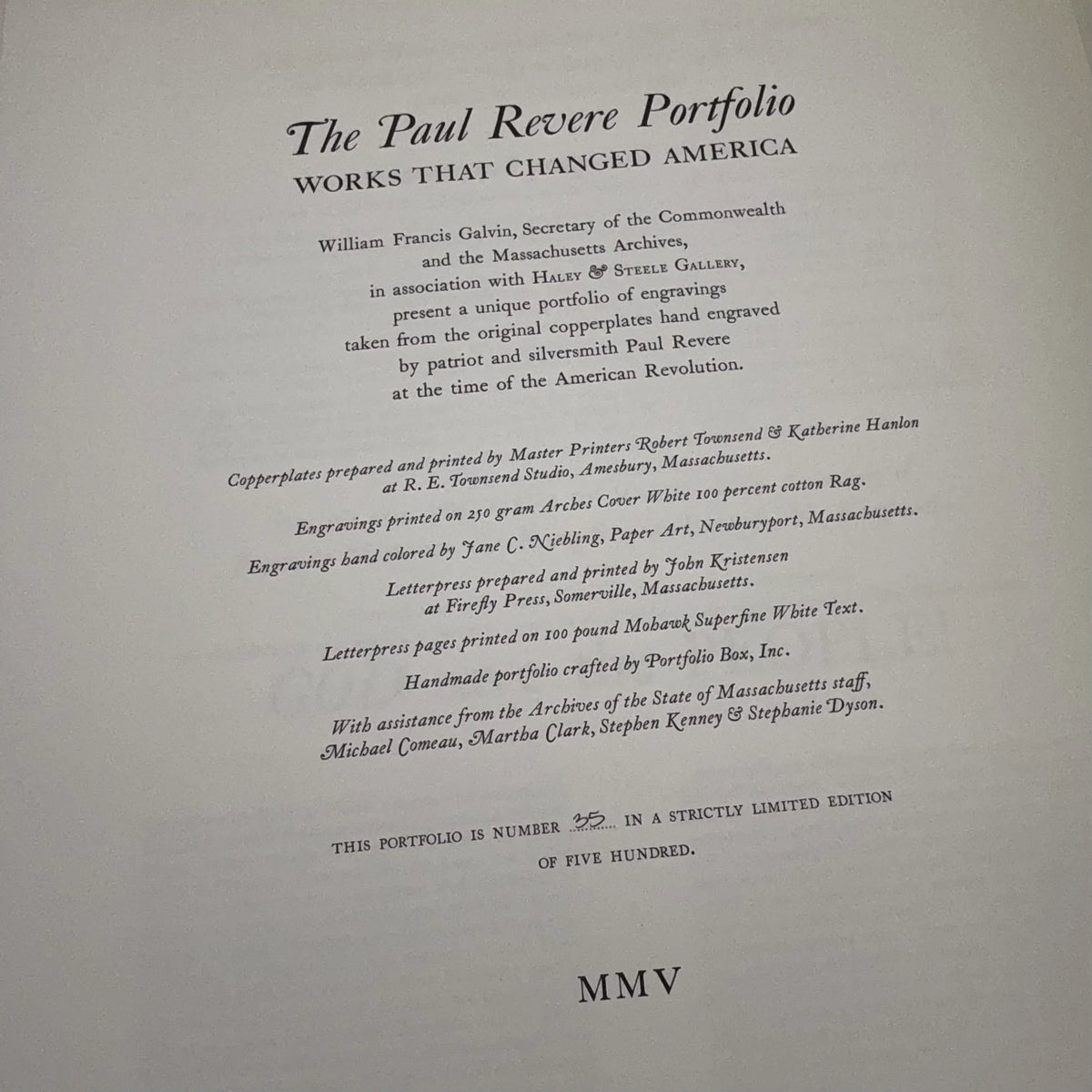
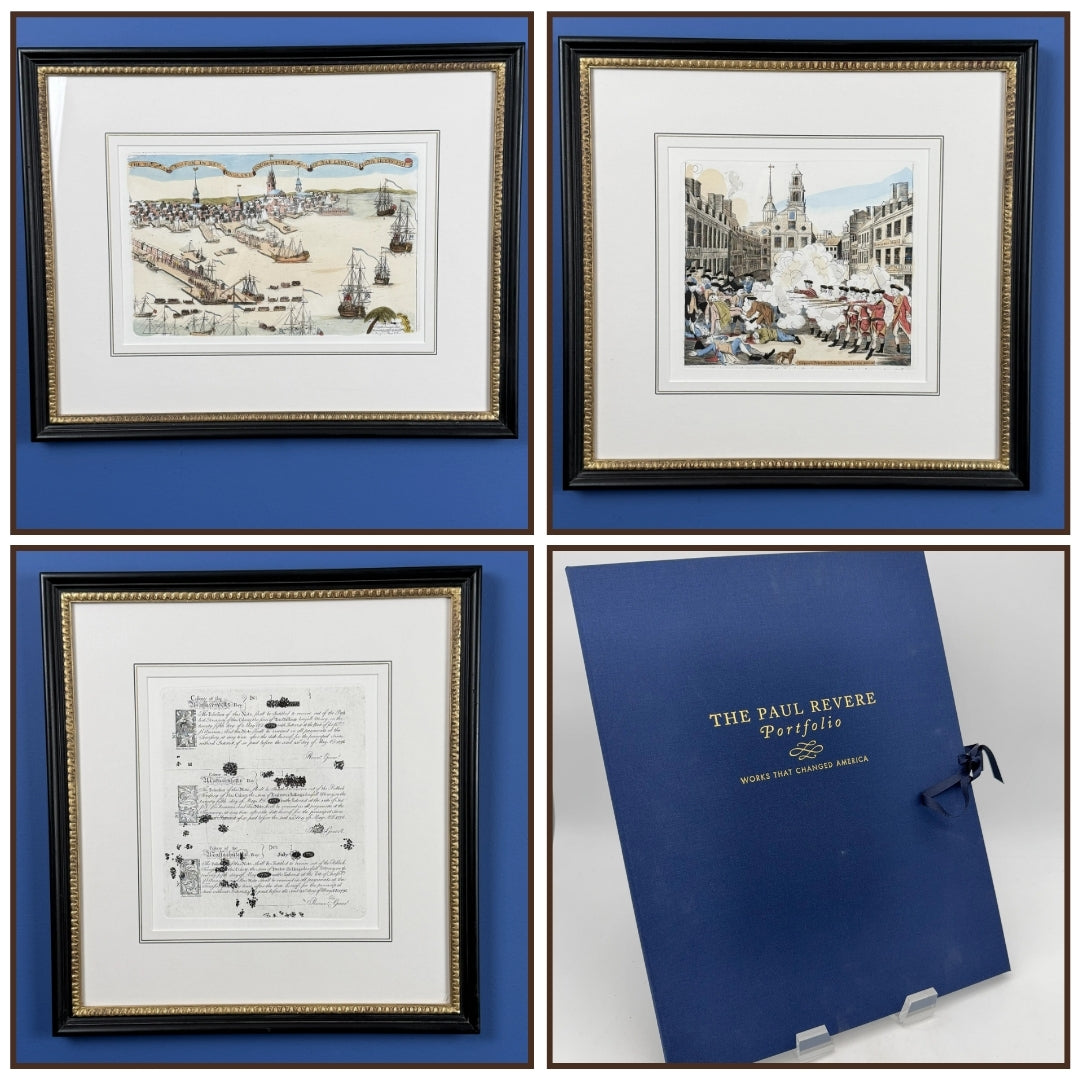
The Paul Revere Portfolio
WORKS THAT CHANGED AMERICA
William Francis Galvin, Secretary of the Commonwealth
and the Massachusetts Archives,
in association with HALEY & STERLE GALLERY,
present a unique portfolio of engravings
taken from the original copperplates hand engraved by patriot and silversmith Paul Revere
at the time of the American Revolution.
Copperplates prepared and primed by Master Printers Robert Townsend 8 Katherine Hanlon
at R. B. Townsend Studio, Amesbury, Massachusetts.
Engravings printed un 250 gram Arebes Cover White 100 percent cotton Rag.
Engravings hand colored by Jane C. Nichling, Paper Art. Nerburyport, Massachusetts.
Letterpress prepared and printed by John Kristensen
at Firelly Press, Sonerville, Massachusett.
Letterpress pages printed on 100 pound Mohard Superfine Wbite Text.
Handmade portfolio crafted hy Portfolio Box, Inc.
With assistance from the Archives of the State of Massachusetts staff,
Michael Comean, Martha Clark, Stephen Kenney & Stephanie Dyson.
THIS PORTFOLIO IS NUMBER 35 IN A STRICTLY LIMITED EDITION OF FIVE HUNDRED.
MMV
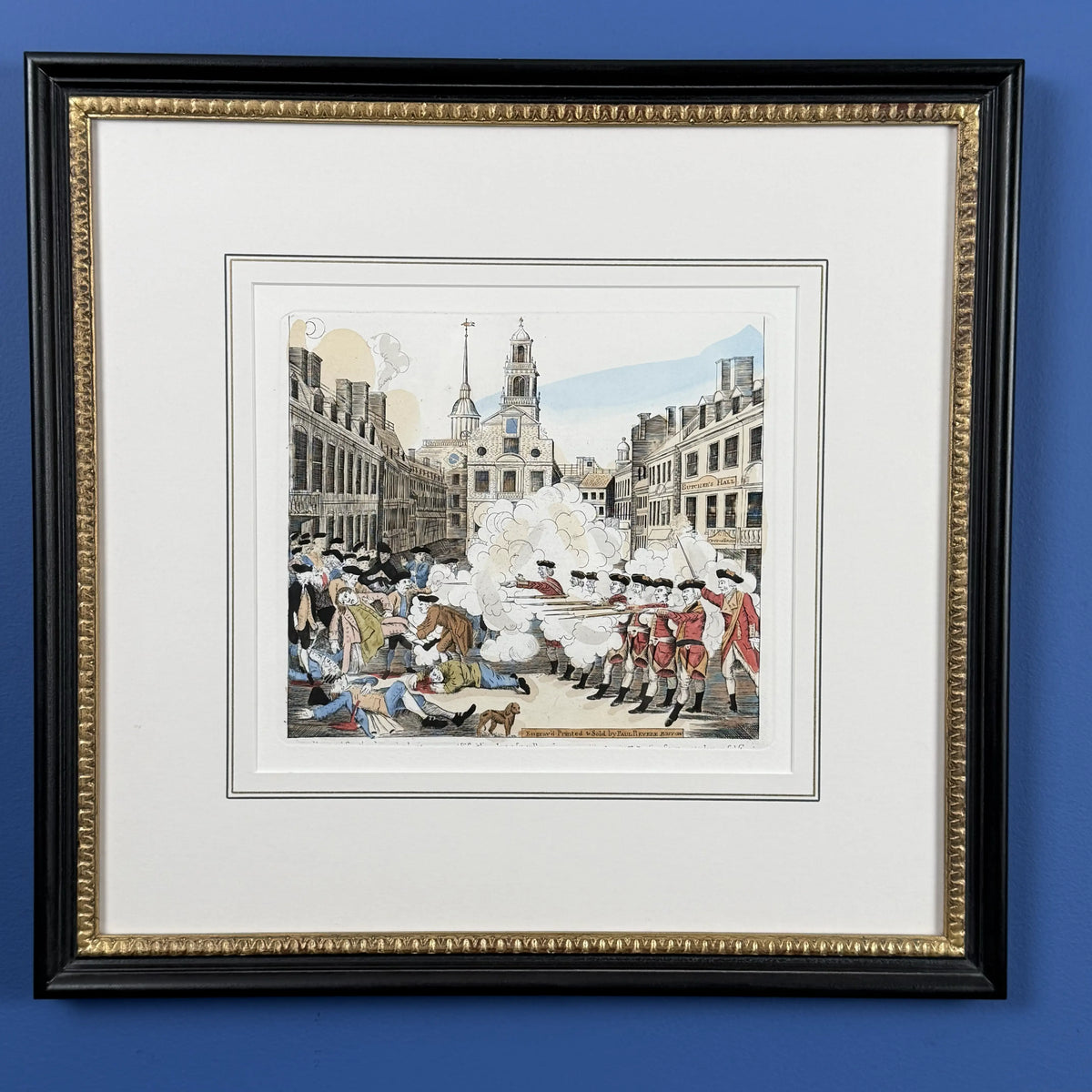
The Bloody Massacre perpetrated in King Street Boston on March 5th 1770 by a Party of the 29th Rest.
ENGRAVED BY PAUL REVERE
As a solemn and perpetual MEMORIAL
Of the Tyranny of the British Administration of Government in the Years 1768, 1769, & 1770 :
Or the fatal and destructive Consequences of quartering Armies, in Time of Peace, in populous Cities:
Of the ridiculous Policy, and infamous Absurdity, of supporting Civil Government by a Military Force:
Of the great Duty and Necessity of firmly opposing Despotism in its first Approaches:
Of the detestable Principles and arbitrary Conduct of those Ministers in Britain who advised, and of their Tools in America who desired, the Introduction of a Standing Army into this Province in the Year 1768:
Of the irrefragable Proof which those Ministers themselves thereby produced, that the Civil Government, as by them administered, was weak, wicked, and tyrannical:
Of the vile Ingratitude and abominable Wickedness of every American, who abetted and encouraged, either in
Thought, Word or Deed, the Establishment of a Standing Army among his Countrymen:
Of the unaccountable Conduct of those Civil Governors, the immediate Representatives of his Majesty, who,
while the Military were triumphantly insulting the whole LEGISLATIVE AUTHORITY OF THE STATE and
while the Blood of the massacred Inhabitants was flowing in the Streets, persisted in repeatedly disclaiming all
Authority of relieving the People, by any the least Removal of the Troops:
And of the savage Cruelty of the IMMEDIATE PERPETRATORS;
BE it forever Remembered,
That this Day, THE FIFTH OF MARCH, is the Anniversary of
Preston’s Massacre in King-Street–Boston, N. England–
1770.
In which Five of his Majesty’s Subjects were slain, and Six wounded,
By the Discharge of a Number of Muskets from a Party of Soldiers under the Command of Capt. Thomas Preston.
GOD save the PEOPLE!
THE TOWN OF BOSTON affords a recent and melancholy Demonstration of the destructive Consequences of quartering Troops among Citizens in a Time of Peace, under a Pretence of supporting the Laws and aiding Civil Authority; every considerate and unprejudiced Person among us was deeply impress with the Apprehension of these Consequences when it was known that a Number of Regiments were ordered to this Town under such a Pretext, but in Reality to inforce oppressive Measures; to awe and control the legislative as well as executive Power of the Province, and to quell a Spirit of Liberty, which however it may have been basely oppos’d and even ridicul’d by some, would do Honor to any Age or Country. A few Persons amongst us had determin’d to use all their Influence to procure so destructive a Measure with a View to their securely enjoying the Profits of an American Revenue, and unhappily both for Britain and this Country they found Means to effect it.
A few minutes after nine o’clock, four youths, named Edward Archbald, William Merchant, Francis Arch-bald, and John Leech, jun. came down Cornhill together, and seperating at Doctor Loving’s corner, the two former were passing the narrow alley leading to Murray’s barrack, in which was a soldier, brandishing a broad sword of an uncommon size against the walls, out of which he struck fire plentifully. A person of a mean countenance armed with a large cudgel bore him company. Edward Archbald admonished Mr. Merchant to take care of the sword, on which the soldier turned round and struck Archbald on the arm, then pushed at Merchant and pierced thro’ his cloaths inside the arm close to the arm-pit and grazed the skin. Merchant then struck the soldier with a short stick he had, & the other Person ran to the barrack & bro’t with him two soldiers, one armed with a pair of tongs and the other with a shovel: he with the tongs pursued Archbald back thrơ’
the alley, collar’d and laid him over the head with the tongs. The noise bro’t people together, and John Hicks, a young lad, coming up, knock’d the soldier down, but let him get up again; and the more lads gathering, drove them back to the barrack, where the boys stood some time as it were to keep them in. In less than a minute 10 or 12 of them came out with drawn cutlasses, clubs & bayonets, and set upon the unarmed boys and young folks, who stood them a little while, but finding the inequality of their equipment dispersed.-On hearing the noise, one Samuel Atwood, came up to see what was the matter, and entering the alley from dock-square, heard the latter part of the combat, and when the boys had dispersed he met the 10 or 12 soldiers aforesaid rushing down the alley towards the square, and asked them if they intended to murder people? They answered Yes, by G-d, root and branch! With that one of them struck Mr. Atwood with a club, which was repeated by another, and being unarmed he turned to go off, and received a wound on the left shoulder which reached the bone and gave him much pain. Retreating a few steps, Mr. Atwood met two officers and said, Gentlemen, what is the matter? They answered you’ll see by and by. Immediately after, those heroes appeared in the square, asking where were the boogers? where were the cowards? But notwithstanding their fierceness to naked men, one of them advanced towards a youth who had a split of a raw stave in his hand, and said damn them here is one of them; but the young man seeing a person near him with a drawn sword and good cane ready to support him, held up his stave in defiance, and they quietly passed by him up the little alley by Mr. Silsby’s to Kingstreet, where they attacked single and unarmed persons till they raised much clamor, and then turned down Cornhill street, insulting all they met in like manner, and pursuing some to their very doors. Thirty or forty persons mostly lads, being by this means gathered in Kingstreet, Capt. Preston, with a party of men with charged bayonets, came from the main guard to the commissioners house, the soldiers pushing their bayo-nets, crying, Make way! They took place by the custom-house, and continuing to push to drive the people off, pricked some in several places; on which they were clamorous, and, it is said, threw snow-balls. On this, the Captain commanded them to fire, and more snowballs coming, he again said, Damn you, Fire, be the consequence what it will! One soldier then fired, and a townsman with a cudgel struck him over the hands with such force that he dropt his firelock; and rushing forward aimed a blow at the Captain’s head, which graz’d his hat and fell pretty heavy upon his arm: However, the soldiers continued the fire, successively, till 7 or o, or as some say Il guns were discharged.
By this fatal manoeuvre, three men were laid dead on the spot, and two more struggling for life, but what shewed a degree of cruelty unknown to British troops, at least since the house of Hanover has directed their operations, was an attempt to fire upon or push with their bayonets the persons who undertook to remove the slain and wounded!
Mr. Benjamin Leigh, now undertaker in the Delph Manufactory, came up, and after some conversation with Capt. Preston, relative to his conduct in this affair, advised him to draw off his men, with which he complied.
The dead are Mr. Samuel Gray, killed on the spot, the ball entering his head and beating off a large portion of his skull.
A mulatto man, named Crispus Attucks, who was born in Framingham, but lately belonged to New-Prov-idence and was here in order to go for North-Carolina, also killed instantly; two balls entering his breast, one of them in special goring the right lobe of the lungs, and a great part of the liver most horribly.
Mr. James Caldwell, mate of Capt. Morton’s vessel, in like manner killed by two balls entering his back.
Mr. Samuel Maverick, a promising youth of 17 years of age, son of the Widow Maverick, and an apprentice to Mr. Greenwood, Ivory-Turner, mortally wounded, a ball went through his belly, & was cut out at his back:
He died the next morning.
A lad named Christopher Monk, about 17 years of age, an apprentice to Mr. Walker, Shipwright; wounded, a ball entered his back about 4 inches above the left kidney, near the spine, and was cut out of the breast on the same side; apprehended he will die.
A lad named John Clark, about 17 years of age, whose parents live at Medford, and an apprentice to Capt.
Samuel Howard of this town; wounded, a ball entered just above his groin and came out at his hip, on the opposite side, apprehended he will die.
Mr. Edward Payne, of this town, Merchant, standing at his entry-door, received a ball in his arm, shattered some of the bones.
Mr. John Green, Taylor, coming up Leverett’s Lane, received a ball just under his hip, and lodged in the under part of his thigh, which was extracted.
Mr. Robert Patterson, a seafaring man, who was the person that had his trowsers shot through in Richard-son’s affair, wounded; a ball went through his right arm, and he suffered great loss of blood.
Mr. Patrick Carr, about 30 years of age, who work’d with Mr. Field, Leather-Breeches-maker in Queenstreet, wounded, a ball enter’d near his hip and went out at his side.
A lad named David Parker, an apprentice to Mr.
Eddy the Wheelwright, wounded, a ball entered in his thigh.
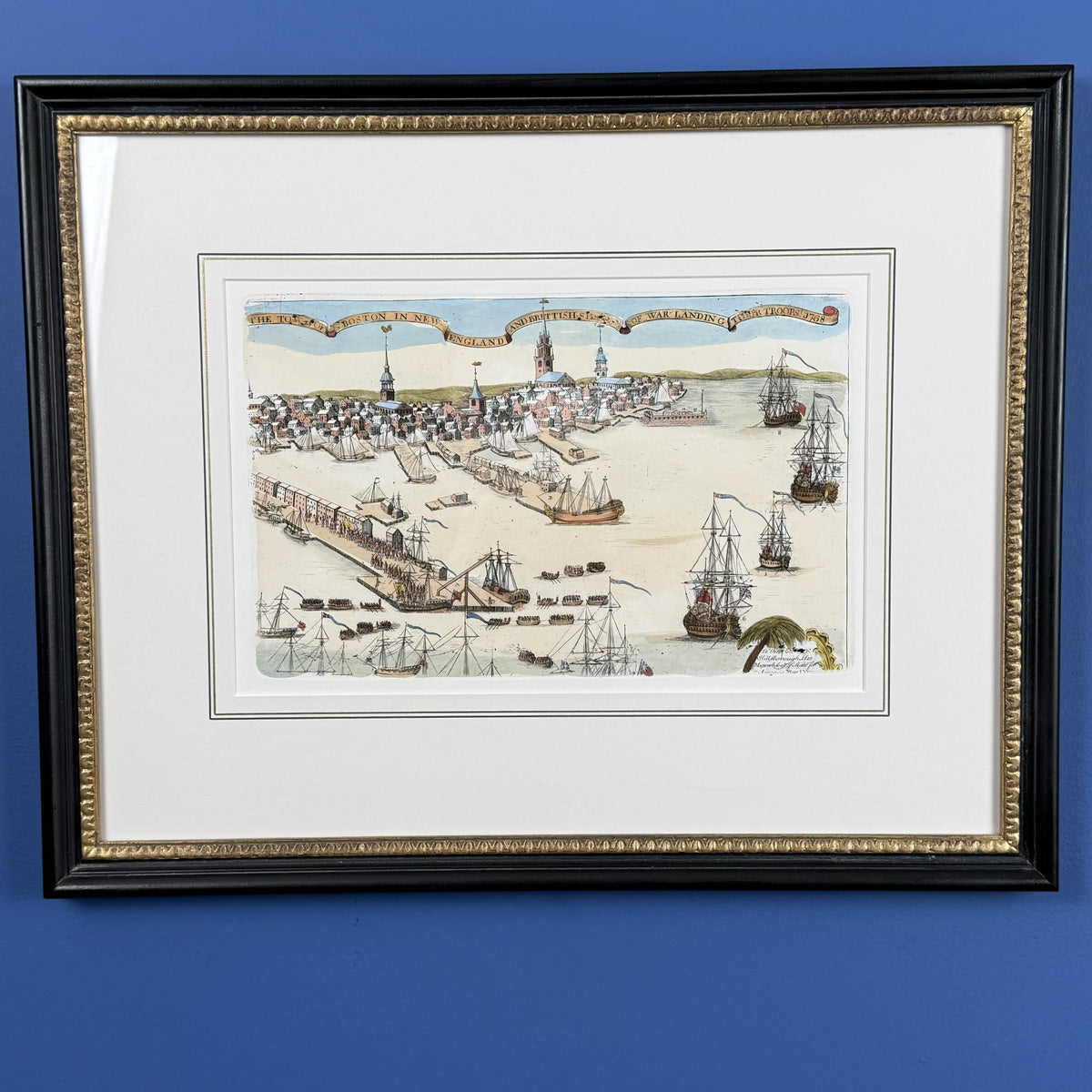
A View of Part of the Town of Boston in New England and British Ships of War landing their Troops, 1768
ENGRAVED BY PAUL REVERE
For BOSTON IN 1768, smuggling was rife, the Massachusetts Assembly was behaving and ruling in the style of a Sovereign Nation and the Sons of Liberty were making life unbearable for customs officials. Finally, their repeated threats to the houses and persons of the customs commissioners, the Sons of Liberty had overplayed their hand. Fed up, the goaded Governor of Massachusetts, Francis Bernard, asked England for two regiments of troops to keep order. On September 30, 1768, a British feet anchored in Boston Harbor “as for a regular siege,” the purpose of which was to protect Royal officials in the execution of their duties. The next day, October 1st, soldiers drawn chiefly from the 14th and 29th Infantry Regiments, and numbering about 700 men, landed at Boston without opposition. Six weeks later the 64th and 65th Regiments, of about 500 men each, began to arrive from Ireland and debarked at Long Wharf. Reassured by the presence of the troops sent for their protection, the Commissioners of Customs who fled after the Boston riot of June 1768, now returned to the town.
In this, one of the most famous and elaborate of Paul Revere’s engravings, it shows the arrival of the red-coated British troops. Revere wrote that the troops “formed and marched with insolent parade, drums beating, fifes playing, and colours flying, up King Street. Each soldier having received 16 rounds of powder and ball.” Troops of the 29th, unables to secure lodgings in town, pitched tents on the common.
When Bostonians refused to house the soldiers, British officers commandeered public and
Frequently, the ill-fed, ill-paid men hired themselves out for menial jobs at low wages, incurring the bitter wrath of Boston’s unemployed. Street fights flared, mobs and children taunted the troops with cries of “bloodybacks,” and “lobsterbacks,” all the while Samuel Adams and his Sons of Liberty maneuvered in the background, fanning the flames of revolt. Even under normal circumstances the presence of General Thomas Gage’s troops (nearly one for every four inhabitants) would have led to trouble. Now, the imposition of an occupation force on a city already torn with strife, made bloodshed a foregone conclusion.
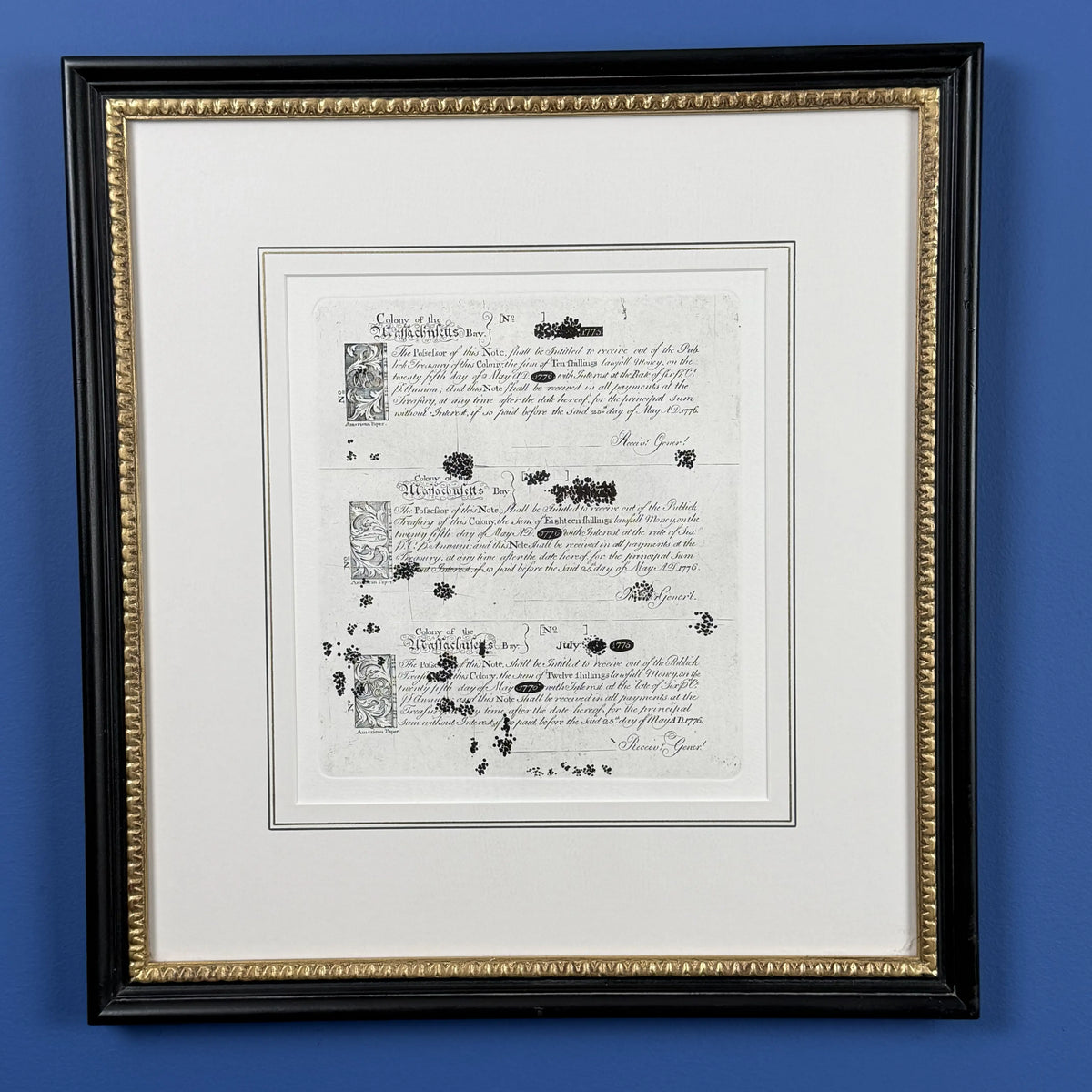
Soldier’s Pay 1775-1776
ENGRAVED BY PAUL REVERE
SECOND PROVINCIAL CONGRESS.
[May 20, 1775.]
Resolved, That for the payment of advance pay to the Massachusetts army, there be issued by the receiver general, on the credit of this colony, a sum not exceeding twenty six thousand pounds, lawful money, in notes of the following denominations, viz.: of twenty shillings, of eighteen, sixteen, fifteen, fourteen, twelve, ten, nine, and of six shillings; to be four thousand, three hundred, and thirty-three, of each denomination, and no more; and to be in the form following, viz.:
COLONY OF THE MASSACHUSETTS BAY.
No. May 25, 1775•
The possessor of this note shall be entitled to receive, out of the public treasury of this colony, the sum of
shillings, lawful money, on the twenty-fifth day of May, A. D., 1776, with interest, at the rate of six per cent. per annum; and this note shall be received in all payments at the treasury, at any time after the date hereof, for the principal sum, without interest, if so paid before the said 25th day of May, A. D., 1776.
Receiver General.
Which notes shall be received in all payments in this colony, and no discount or abatement shall be made thereon, in any payment, trade, or exchange whatsoever.
THIRD PROVINCIAL CONGRESS. [JULY 7, 1775]
The committee appointed to consider the resolve of the committee of safety relative to a new emission of bills of credit, reported. The report was accepted, and is as follows, viz.: Whereas, several persons have been employed in the service of this colony, and several have supplied small articles, whose accounts amount severally to small sums only, and it appearing to this Congress, that the plates engraved for impressing or striking off the bills for the payment of the soldiers in the service of this colony are still sufficient for the striking off a number of impressions on each plate; therefore, Resolved, that there be impressed, or struck off, on the plate containing the engraving for notes of ten shillings, eighteen shillings and twelve shillings, six hundred and sixty-seven sheets, and no more; and that there be impressed, or struck off, on the plate for notes of sixteen shillings, fifteen shillings and nine shillings, six hundred and sixty-seven sheets, and no more; and also on the plate for twenty shillings, fourteen shillings, and six shillings, that there be impressed, or struck off, five hundred and forty sheets, and no more: which last number, together with one hundred and twenty-seven sheets, or impressions, already struck off on that plate, and not signed, make the like number of six hundred and sixty-seven sheets, or impressions, which, together, amount to two thousand and one sheets, or impressions, each sheet containing forty shillings, amounting to the sum of £4002, which, together with the sum of £25,998, already perfected of those notes, make the sum of £30,000.
We also report, that a committee be appointed to agree with Mr. Revere, or some other suitable person, for the striking off the above number of sheets. Also, that a committee be appointed to authenticate said sheets, when they are struck off.
Ordered, That Deacon Mitchell, Capt. Holmes, and Capt. Stone, of Framingham, be a committee to agree with some persons to strike off the bills, agreeably to the foregoing report.
Share This Story, Choose Your Platform!
Related Posts